
Low MOQ Custom Jewelry Wholesale: What 50 Pieces Buys
Fifty pieces is the published entry point for 316L stainless steel, artisan eco-brass and 925 silver at 100+. That gap of exactly half is the difference between testing a design in the market and committing to it properly, so it is worth knowing what the smaller order does and does not include.

Key takeaways
- The silver floor is 50 pieces per design — exactly half the 100-piece artisan eco-brass floor.
- CAD comes back CAD 48 hours, 25–30 days, 3–4 weeks — CAD, sample, run — CAD, sample, run — CAD, sample, run — CAD, sample, run — CAD, sample, run.
- Low MOQ policies are published with the stated aim of minimal inventory risk for the buyer.
- The approved master sample is the benchmark for every repeat, so batch #10 matches batch #1.
Why 50 pieces exists as a floor
A minimum order quantity is a tooling statement rather than a sales threshold. Silver casts cleanly and polishes in a few bench passes, so a 50-piece design can absorb the mould and the sample without the buyer carrying stock they cannot sell. The published framing is a flexible low MOQ policy designed to keep inventory risk minimal, which is a buyer-side argument as much as a production one.
Compare the three floors directly. Fifty pieces in silver is half of the 100-piece brass floor and less than half of the 100+ stainless floor. For a brand testing a category, that is the difference between one design with cash left over and three designs with none.
What 50 pieces actually contains
The order contains one design, one CAD file, one mould and one master sample, and it carries the same process as a larger run. CAD is quoted at under 48 hours, the master sample at 25–30 days, and production at 3–4 weeks after approval. Nothing in that sequence is shortened or bypassed because the quantity is small.
It also contains the same protection. The published position is a 100% NDA with moulds, CAD files and the collection kept exclusive to the buyer's brand, so a small order does not become a shared design. Add 100% inspection before delivery and the 1-on-1 project manager, and the practical difference between a 50-piece order and a 500-piece one is limited to how thinly the fixed costs spread.
Spending 50 pieces sensibly
Fifty pieces across five sizes is 50 ÷ 5 = 10 pieces per size, which is enough to read a size curve but too thin to run a promotion. The usual pattern for a first order is one design in four or five sizes, with the hero size weighted slightly heavier than the rest. For a single-size piece such as a pendant, the whole floor concentrates on one SKU.
, and a two-design order doubles the totalme piece count as one design in artisan eco-brass. That comparison is the whole planning decision in one line: the smaller floor in silver buys breadth, while the brass floor buys a plated look at a lower unit cost.
| Item | Published figure | What it means for a small run |
|---|---|---|
| 925 sterling silver floor | 50 pcs per design | The lowest entry point in the range |
| Artisan eco-brass floor | 100 pcs per design | Twice the silver floor for a plated finish |
| Stainless steel floor | 100+ pcs per design | Machining plus PVD finishing |
| Sampling window | 25–30 days | Unchanged by order size |
| Production block | 3–4 weeks | Unchanged by order size |
What the small order does not buy
It does not buy a shorter development cycle, and it does not buy a cheaper sample. The 25–30 day sampling window is a per-design cost, so a 50-piece order pays the same sample once as a 5,000-piece order pays once. What it avoids is inventory, not process.
It also does not buy exclusivity by default anywhere except under the published NDA terms, so confirm that in writing. And it does not remove the confirmation gate: the master sample still has to be approved by the buyer before production is released, which is why the sample should be reviewed in daylight rather than by photograph.
Where the low floor fits in a program
Wholesale work in this range is described as a five-step flow: concept and design, master sampling, quality inspection, sample confirmation and mass production. A 50-piece order walks through all five steps, and the value of the small floor is that it lets a brand run those five steps once, learn the part that cannot be learned from a catalogue, and then scale the design that worked.
That is what a wholesale jewelry OEM services relationship looks like at the small end: one design tested properly rather than five designs guessed at. The published intent is a long-term production partner rather than a one-off supplier, and a low floor is how that relationship gets started.
Worked example: what 50 pieces divides into
Take silver at the published floor and split it across sizes. Five sizes gives 50 ÷ 5 = 10 pieces per size. Seven sizes gives 50 ÷ 7 = 7.1 pieces per size, which is a number no factory will produce as a partial piece, so the size run usually narrows rather than the quantity rising.
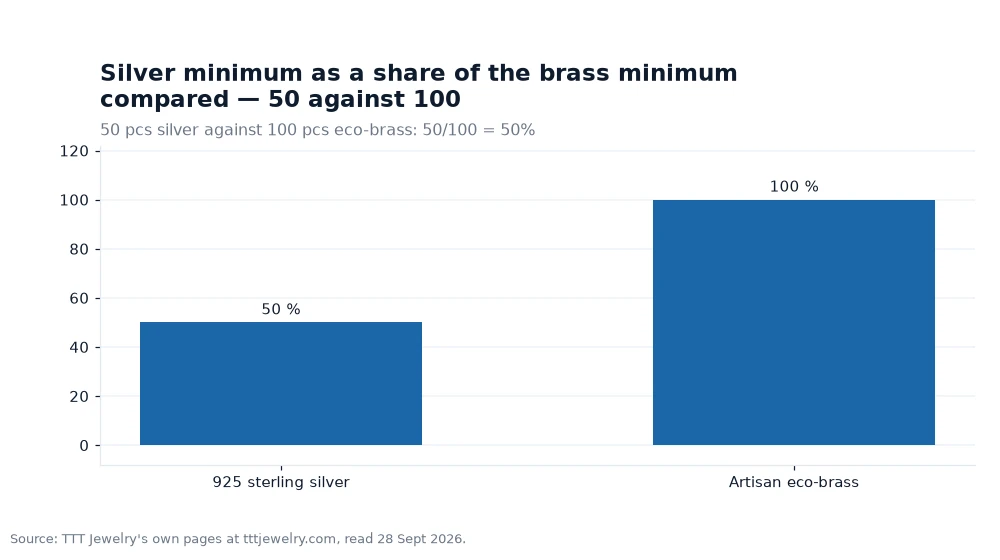
Then compare the two materials at the same spend. Fifty pieces of silver is 50 ÷ 100 = 50% of the brass floor, so the same cash buys either two silver designs at the floor or one brass design at its floor. Both figures are my own arithmetic on published floors; the floors themselves — 50, 100 and 100+ pieces per design — are the published ones.
Repeat orders at the small end
The second order is where a low floor pays off twice. Because the tooling and the CAD file already exist and the design has been confirmed against the benchmark sample, a repeat can be placed against the production window alone, at 3–4 weeks, without a new sampling round. The tenth batch is checked against the same reference as the first, which means the market feedback from the small first order is still valid months later.
Set the reorder point against sell-through rather than against a calendar. For a brand with a few designs live, that converts a custom jewelry wholesale program from a guess into a moving average.
Frequently asked questions
Is 50 pieces per design the lowest available order?
Yes. The published minimums are 50 in sterling silver, 100+ pieces in stainless work and 100 units in artisan brass, for each design, and they hold design by design.
Does a 50-piece order get the same quality process?
Yes. CAD inside 48 hours, a 25–30 day master sample, 100% inspection before delivery and the same materials and plating options apply to a small run as to a large one.
Can I split 50 pieces across two designs?
No, the floor applies per design: two silver designs means 2 × 50 = 100 pieces, and each design also needs its own sample and tooling.
Starting with the smallest commitment that works
If the goal is to learn what sells, silver at 50 pieces per design is the least expensive way to find out, provided the brief is complete before the sample is built. Read the brass plating and oxidation finishes before settling price bands, and check the plating and polishing stages if you want to know where a small run's quality actually comes from.
The source for the claims above — the 14K / 18K / 24K gold and rhodium plating list plus the packaging set plus the five-stage service route — is the manufacturer's own site on tttjewelry.com's own pages (read 28 Sept 2026). No figure above is estimated. The chart's relative scale is mine[1].