
Private Label Perfume: The Compliance File a Direct-to-Consumer Brand Needs
A direct-to-consumer brand that sells private label perfume carries the compliance responsibility itself, because there is no retailer between the factory and the customer to hold the file. The practical consequence is simple: before the first order ships, the brand should own a defined set of documents, know who issued each one, and know what question each document answers. That file is finite and can be assembled in an afternoon of asking, but only if the brand asks for it before production rather than after a marketplace request arrives.
Key takeaways
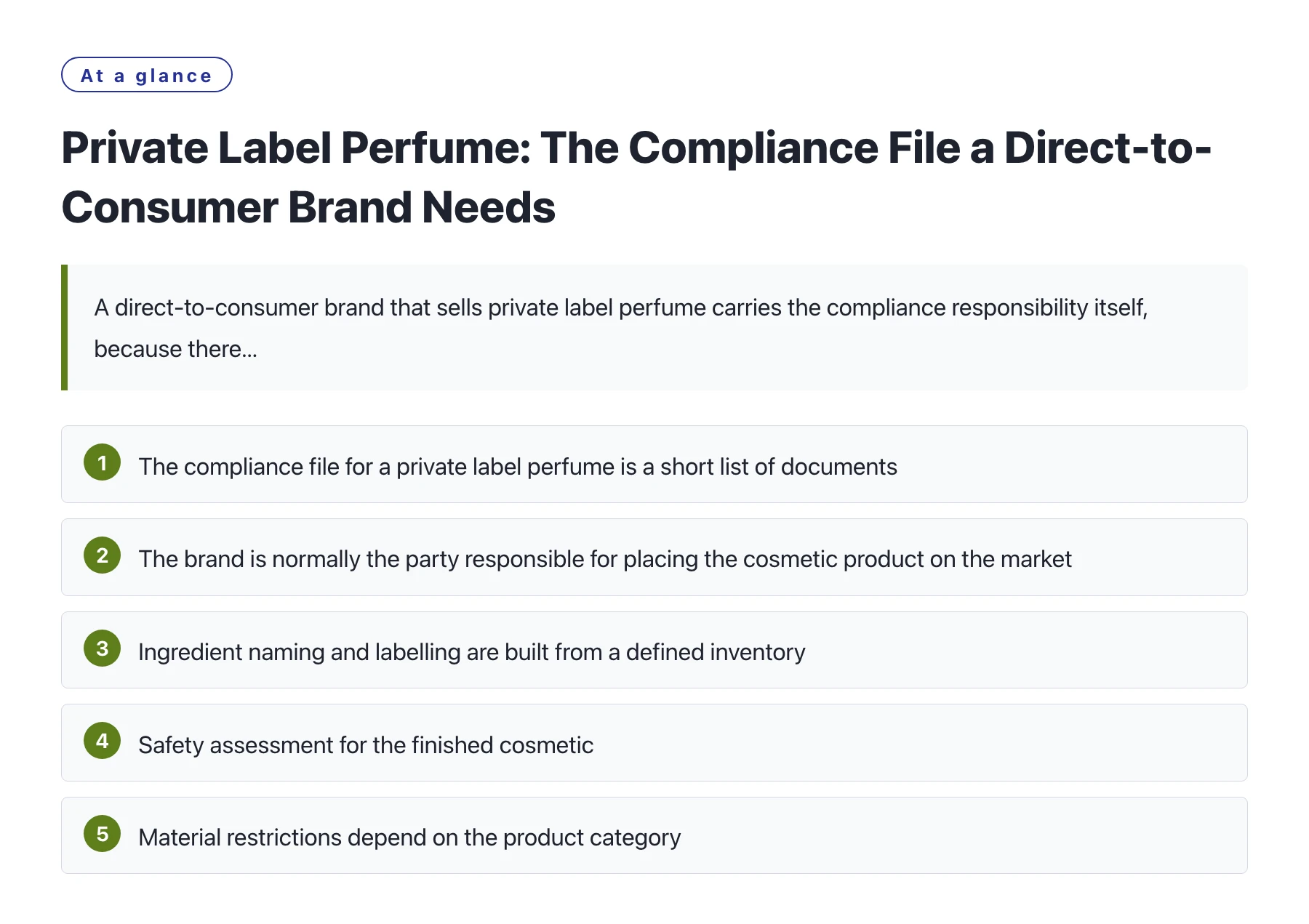
- The compliance file for a private label perfume is a short list of documents, and each entry exists to answer a specific question from a regulator, a payment provider or a customer.
- The brand is normally the party responsible for placing the cosmetic product on the market, which is why the file has to live with the brand and not only with the factory [1].
- Ingredient naming and labelling are built from a defined inventory, so the brand should be able to trace every declared ingredient term back to a source [2].
- Safety assessment for the finished cosmetic, not only for the fragrance compound, is a separate piece of work and should be named explicitly in the supplier agreement.
- Material restrictions depend on the product category, so a private label brief that spans a perfume, a body lotion and a home spray needs the restricted-material position checked per category, not once [3].
- Independent test reports are what turn a supplier's statement into evidence, and they should name the formula, the batch and the package they describe [4].
Private label fragrance sounds like a low-effort route to a product line: choose from a library, put a name on the bottle, sell it. The manufacturing part can indeed be simple. The compliance part is where direct-to-consumer brands get caught, because a marketplace, a payment processor or a customs officer will eventually ask for something specific, and by then the sample that would have answered the question is long gone.
The file below is written from the position of a brand that sells through its own website and its own ads, with no retail buyer to inherit part of the burden. It is deliberately practical: what to hold, who issues it, and what it protects against.
The documents, and the question each one answers
| Document | Who issues it | The question it settles |
|---|---|---|
| Fragrance compound specification | The fragrance supplier | What exactly is in the scent, at what concentration, and against which standard it was assessed |
| Restricted-material statement per product category | The fragrance supplier, with the brand's product list attached | Whether the formula is within use limits for each product it will be sold in, not only the flagship one |
| Safety assessment or toxicological report for the finished product | A qualified assessor, commissioned by the brand or the manufacturer | Whether the finished cosmetic, including packaging and use instructions, can be placed on the market |
| Ingredient list and labelling artwork approval | Brand, checked against the supplier's declaration | Whether the label matches the formula that is actually being filled |
| Certificate of analysis for the bulk batch | The manufacturer's quality function | Whether the batch that shipped matches the approved reference |
| Compatibility and stability test summary | The manufacturer or an independent laboratory | Whether the scent holds in that bottle, that pump and that storage condition for the intended shelf life |
| Manufacturing and quality system certificates | The manufacturer, with scope and validity dates | Which management systems are in place, and which site they cover |
| Origin and shipping documentation | Manufacturer and freight parties | What is moving, from where, and under which tariff description |
None of these documents is exotic, and most manufacturers produce them as a matter of routine. What separates a comfortable launch from a difficult one is whether the file is assembled at the brief stage or reconstructed under deadline. A private label program works best when the Xuelei's factory treats documents as a standard deliverable rather than an exception, and when the brand asks for the list in writing before the purchase order is raised.
What a direct-to-consumer brand has to do differently
A brand selling through retail chains can rely on the retailer to demand part of the file, and often to check it. Selling direct removes that filter. The brand's own name appears on the listing, the brand answers the customer, and the brand is the entity a regulator will contact. In many markets that places the brand in the position of the responsible party for the cosmetic product, which means the safety assessment and the product information file have to exist whether or not anyone asks to see them [1].
The second difference is ingredient language. Direct-to-consumer listings are read by customers and by automated systems, and an incorrect ingredient term is both a trust problem and a compliance problem. The declared names come from a defined inventory rather than from memory, and cross-checking the label against that inventory is a fifteen-minute task that prevents a relabelling exercise later [2].
Why category matters more than the brand expects
A direct-to-consumer brand rarely launches one product. A scent may go into a spray, a body oil, a hair mist and a diffuser refill in the same season, and each of those categories applies different use restrictions to the same formula. The restricted-material conversation therefore has to happen with the full product list visible, ideally before the formula is locked, because a limit that is comfortable in fine fragrance can be exceeded in a leave-on body product [3].
The practical habit is to attach the product plan to the brief and to ask for the restricted-material position as a table, one row per category. When the answers arrive as a table, an inconsistency is visible immediately, and the reformulation decision can be made before the packaging is ordered.
The difference between a claim and a report
Suppliers describe stability, compatibility and microbiological work in confident language, and that is not dishonest, but it is not evidence either. What turns it into evidence is a report that names the formula version, the batch, the packaging combination and the test conditions, and that is signed by whoever ran the work [4]. Direct-to-consumer brands should ask for one sample report at the quotation stage, because a supplier that can produce one quickly will produce the rest on the same pattern.
It also helps to agree in advance where the reports live and who pays for repeats. If the scent is reformulated for a second category, some of the earlier work no longer applies, and knowing that up front prevents an awkward conversation in the middle of a launch.
How to keep the file alive after launch
A compliance file is not finished at launch; it becomes stale as soon as something changes. Reformulations, packaging switches, new markets and revised labelling rules all invalidate part of it. The low-effort way to manage that is a single index page, held by the brand, listing each document with its issue date, its version and the change that would trigger a replacement.
For a direct-to-consumer brand, the index is also an operational tool. When a marketplace asks a specific question, the answer is a row in the index rather than a search through an inbox. When a range expands, the index shows which documents carry over and which have to be redone. And when a supplier changes, the index shows exactly what the new partner has to reproduce, which is the difference between a controlled transition and a relaunch.
If the brand has to shorten this to one instruction, it is this: ask for the document list before asking for the price. A supplier that responds with a structured list, complete with scope and validity, is showing that its paperwork is a system. A supplier that responds with two certificates and a promise is showing something else. It is a quick test, it costs nothing, and it tells a direct-to-consumer brand more about the next three years of the relationship than a showroom visit does. Buyers who want to see how the pieces connect in practice can look at Xuelei and then at the operating scope behind one-stop fragrance manufacturing, which together show where the document responsibilities normally sit between the two parties.
Sources
- European Commission: Cosmetics in the EU —— The European Commission's overview of EU cosmetics rules, including the responsible person, product information file and safety report requirements.
- EU CosIng — Cosmetic Ingredient Database (European Commission) —— The European Commission's CosIng database of cosmetic ingredients, listing ingredient functions, restrictions and labelling requirements under EU cosmetics law.
- IFRA Standards Library (International Fragrance Association) —— The IFRA Standards Library lists the restrictions the fragrance industry applies to individual fragrance ingredients, based on safety assessments; it is the reference point for compliant fragrance formulation.
- SGS: Cosmetics, Personal Care & Household Testing —— Testing, inspection and certification services for cosmetics and personal care, including microbiological, stability and safety testing aligned with cosmetics GMP.
Frequently asked questions
Who is responsible for compliance when a brand buys private label perfume?
In most markets the brand placing the cosmetic product on the market carries the responsibility, even though the manufacturer performs the work. The practical split is that the manufacturer provides the formula, batch and system documentation, while the brand holds the product information file and commissions or obtains the safety assessment for the finished product.
Do we need a safety assessment for a private label perfume that already exists in a library?
Yes. A library scent may have been assessed as a fragrance compound, but the finished cosmetic assessment depends on the product form, the concentration used, the packaging and the labelling. Those variables are set by the brand's product, not by the compound, so the finished product assessment is separate work.
How long should a perfume brand keep compliance documents?
Retention periods vary by market, and they are usually counted from the last batch placed on the market rather than from the first. Keeping the file for as long as the product is sold, plus the local retention period afterwards, is the safe approach, and a versioned index makes that manageable.
What is the difference between a certificate of analysis and a stability report?
A certificate of analysis records what a specific batch measured against the approved specification at the time of manufacture. A stability report describes how a formula and package behave over time and under defined conditions. One is a batch record, the other is a design record, and a launch normally needs both.
Can a private label manufacturer refuse to share the formula document?
A manufacturer may not hand over the complete composition, particularly where the formula remains its property, but it should still provide the documentation the brand needs to sell legally: the declaration, the restricted-material position by category, the safety inputs and the batch records. Those obligations belong in the supply agreement rather than in a later request.
See the signal 7 days before the CDC.
Book a 20-minute walkthrough of the FluTrack Outbreak Dashboard with one of our epidemiologists.